Brazil Prediction Markets Face Illegal Gambling Risk
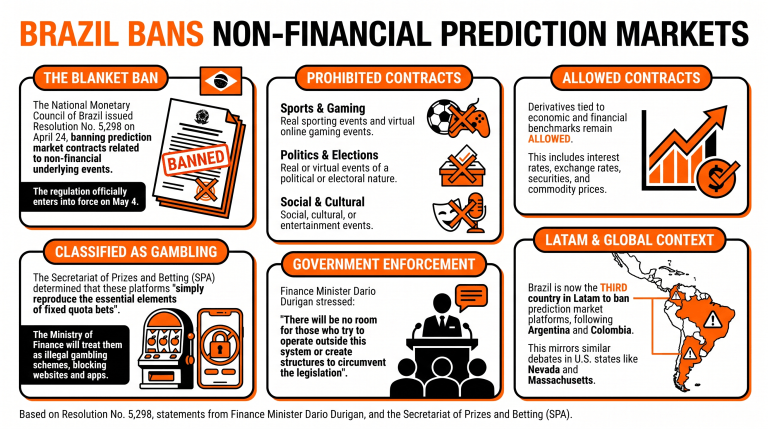
If you operate, promote, or invest in event-based trading products, Brazil deserves your attention right now. Brazil prediction markets sit in a legal gray zone that looks less gray by the week. Regulators and legal experts are asking a blunt question. Are these products financial instruments, or are they just gambling dressed up with trading language?
That matters because Brazil is building a regulated betting market while also tightening rules around who can offer what. A platform that lets users trade on election results, sports outcomes, or other public events may think it is offering market exposure. Brazilian authorities may see something else entirely. And if that view hardens, operators could face enforcement, payment friction, and a fast exit from the market.
What matters most right now
- Brazilian authorities may view some prediction market products as illegal gambling rather than regulated financial activity.
- The legal test turns on substance, not branding. Calling a wager a contract does not settle the issue.
- Sports-linked and event-linked contracts look exposed because they resemble fixed-odds betting in practice.
- Operators, affiliates, and payment partners should review Brazil-facing activity before enforcement catches up.
Why Brazil prediction markets are under scrutiny
Brazil has spent the past year moving from broad betting legalization to the harder work of licensing, supervision, and consumer protection. That process creates a simple problem for prediction platforms. If a licensed sportsbook must meet strict local rules, why should a parallel product be allowed to offer a near-identical experience outside that system?
Here is the core issue. Many prediction markets let users stake money on a binary outcome and receive a payout if they are right. Strip away the interface, and that can look a lot like betting. Honestly, regulators tend to care more about economic reality than product labels.
If a product mirrors gambling behavior, attracts gambling demand, and pays out based on uncertain events, officials may regulate it as gambling first and ask questions later.
That is the pressure point.
How Brazil prediction markets could be classified
The legal fight will likely turn on classification. One camp argues these contracts belong in a financial or derivatives framework. The other argues they are wagers on uncertain future events, especially where users have no commercial reason to hedge risk and are simply trying to win money from an outcome.
Look at it like architecture. A building can have a sleek glass front, but inspectors still judge the load-bearing structure. Prediction markets may present as trading venues, yet the legal structure beneath them may still look like gambling.
Questions regulators are likely to ask
- What is the underlying event, and is it tied to sports, politics, entertainment, or public interest events?
- Does the user act like an investor managing exposure, or like a bettor chasing a payout?
- How is the product marketed in Brazil?
- Who settles the contract, and under what rulebook?
- Is there any local authorization for the activity?
And there is another angle. Brazil has separate interests at play, including consumer safeguards, tax collection, market integrity, and anti-money laundering controls. A product sitting outside the licensed betting system can irritate every one of those priorities at once.
What makes sports and event contracts especially risky
Not all prediction products carry the same legal exposure. Contracts tied to sports scores, election outcomes, celebrity events, or other headline-driven moments are easier targets because the consumer behavior is obvious. People are not using them to hedge a fuel bill or crop yield. They are taking a view and hoping to cash out.
That distinction matters in Brazil. Licensed betting already covers sports and other fixed-odds style products under a regulated model. So a platform offering event contracts to Brazilian users may look like it is bypassing the front door.
Would a regulator accept that difference as meaningful? I would not bet on it.
What operators and affiliates should do now about Brazil prediction markets
If your business touches Brazil, waiting for a formal crackdown is a bad plan. Enforcement usually feels slow until it is sudden. Then payment blocks hit, partners get nervous, and traffic sources vanish.
Practical checks to run this week
- Review whether your product is accessible to users in Brazil, including mobile apps, mirror domains, and language targeting.
- Audit all marketing copy for betting-style claims, sports references, and payout language.
- Check affiliate campaigns, influencer deals, and media buys aimed at Brazilian audiences.
- Assess whether your payment stack can survive a regulatory challenge in Brazil.
- Get local legal advice on product classification, consumer law, and financial regulation overlap.
Look, one weak point often causes the mess. It might be a Portuguese landing page, a Brazil-focused Telegram funnel, or a sports promo that makes the whole operation look like an unlicensed bookmaker.
The compliance gap that could widen fast
Brazil’s regulated betting regime is built around licensing, responsible gambling controls, KYC, AML checks, and reporting duties. Prediction market platforms that target the same users without matching those obligations create an obvious gap. Regulators do not love gaps. They close them.
That can happen through direct enforcement, public guidance, pressure on payment providers, or broader interpretations from legal authorities. Sometimes the market gets the message before a court ever rules on the finer points.
(And yes, payment companies usually react faster than lawmakers.)
What this means for investors and startup teams
Investors like novel market structure stories, especially when a product can be framed as fintech instead of gaming. But Brazil is a reminder that category risk is non-negotiable. A startup may have strong engagement, solid retention, and a clean product stack. If local regulators think the business is offering illegal gambling, those metrics lose value fast.
Founders should also think beyond black-letter law. Ask how local officials, banks, app stores, ad platforms, and sports-rights holders will read the product. If five gatekeepers treat you like a gambling operator, the academic debate about labels starts to look expensive.
Where the Brazil prediction markets debate may go next
The next phase will likely come from sharper public positioning by regulators, legal analysis around event contracts, and pressure on any operator serving Brazil without a clear local basis. That does not mean every prediction market is dead on arrival. It does mean the easy story, that these platforms sit safely outside gambling law, looks shaky.
My read is simple. Brazil prediction markets will need either a stronger legal foundation or a narrower product scope if they want staying power. Companies that act like this is a branding exercise are missing the point. In Brazil, substance wins. The smart move now is to decide what your product really is before the regulator decides for you.